Exports7 min read
Dimensional weight and packing tips: stop paying to ship empty space from the Dominican Republic
Carriers do not only bill what your cargo weighs. They bill the space it takes up. Smart packing is one of the easiest ways to lower export costs.
Share on Facebook(opens in a new tab)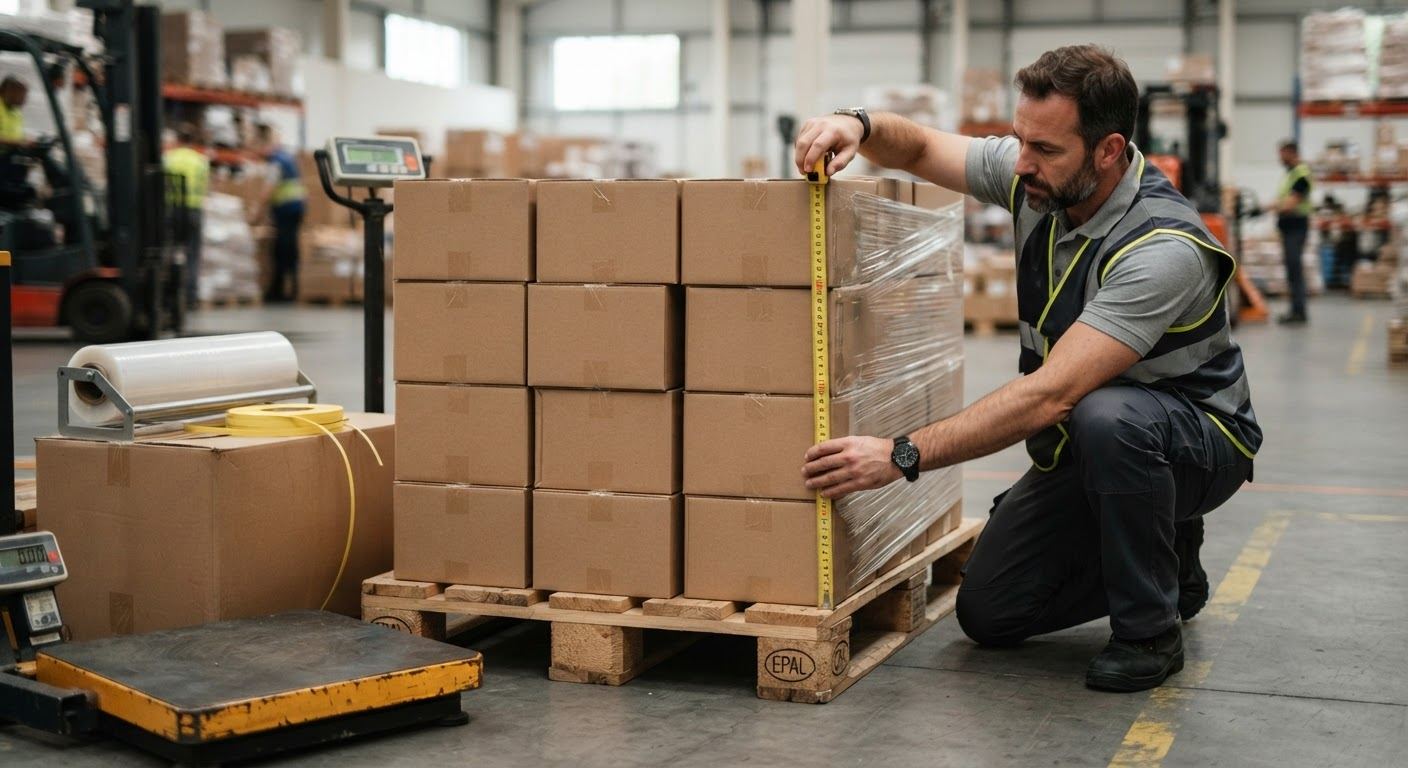
Actual weight vs dimensional weight
Every shipment has two numbers that matter for billing. The actual weight is what the scale says. The dimensional weight, also called volumetric weight, is a weight calculated from the size of your package or pallet. Carriers compare the two and charge on whichever is greater, which is often called the chargeable weight.
This protects carriers from light but bulky cargo that fills an aircraft or container without weighing much. For exporters, it means that a box with too much empty space can cost as much as a heavy one.
How air freight calculates it
For air cargo, the common formula is length × width × height in centimeters, divided by 6,000, which gives a weight in kilograms. Some couriers and express services use a different divisor, so check the one that applies to your service.
A simple example
A carton of 60 × 50 × 50 cm has a volume of 150,000 cm³. Divided by 6,000, that is a dimensional weight of 25 kg. If the carton only weighs 12 kg on the scale, the airline bills it as 25 kg. Cut the carton down to 60 × 50 × 35 cm and the dimensional weight drops to 17.5 kg for the same goods.
How ocean freight calculates it
Consolidated ocean freight (LCL) works on "weight or measure." Your cargo is measured in cubic meters (CBM) and weighed in metric tons, and the greater of the two becomes the billable unit. For most packaged goods the volume is the larger number, so the space your pallets take up drives the cost.
With a full container (FCL) you pay for the box, not the CBM. Packing still matters there: the better you load the container, the more goods fit in it, and the fewer containers you need. Our free CBM, chargeable weight and container calculators do the math for you.
Packing tips that reduce billable size
Small changes in how you pack can add up across an entire shipment.
- Use the smallest box that protects the product safely; avoid oversized cartons
- Standardize carton sizes so they stack in full, even layers
- Replace bulky loose fill with fitted inserts or dividers where possible
- Ship flat-pack or nested items unassembled when the buyer accepts it
- Group small items in master cartons instead of sending many loose pieces
- Measure the final packed size, not the product size, before you request a quote
Palletizing tips for exports
Pallets make handling safer and faster, but a badly built pallet can waste a lot of space.
Avoid overhang and odd heights
Cartons that hang over the edge of the pallet increase its footprint and are easily damaged. Stack within the pallet edges, keep the top flat and choose a height that works well in a container or aircraft position.
Build stable, stackable loads
Strap and stretch-wrap pallets, put heavier cartons on the bottom and use corner boards where needed. Mark non-stackable cargo clearly, but remember that pallets that cannot be stacked may be billed for the space above them.
Use treated wood for international shipments
Wooden pallets and crates for international shipping generally need to meet the ISPM 15 standard (heat-treated and marked). Untreated wood can lead to rejection or fumigation at destination, adding cost and delay.
Products with special needs
Cigars, cocoa, coffee and fresh produce all need packing that protects them from moisture, heat and crushing. Do not cut protection to save space: damaged cargo costs far more than a few extra centimeters. Instead, look for packaging that is both protective and compact, and ask us about refrigerated options for perishables. See the sectors we handle on our exports page.
Accurate measurements prevent surprises
If the dimensions on your booking are smaller than the real cargo, the carrier will re-measure and re-bill. Measure each piece after packing and send the real numbers. It is one of the habits we recommend in how to lower shipping costs from the Dominican Republic.
Not sure whether air or ocean is better once the chargeable weight is known? Read air vs ocean freight in the Caribbean or, if you ship a few pallets at a time, consolidated shipping from the Dominican Republic.
Get a quote with your real numbers
Rates depend on your chargeable weight, route, mode and service level. Once you have your dimensions and weights, send them through the quote page and we will tell you the most economical way to ship.
Frequently asked questions
What is chargeable weight?
It is the weight a carrier bills: the greater of the actual weight and the dimensional (volumetric) weight calculated from the size of the cargo.
What divisor is used for air freight dimensional weight?
Air cargo commonly uses length × width × height in centimeters divided by 6,000. Some courier and express services use a different divisor, so confirm it for your service.
Does dimensional weight apply to a full container?
No. With a full container you pay for the container itself. Packing efficiently still helps you fit more goods and need fewer containers.